
No Gilpin Arrest Blotter
Gilpin County publishes no 72-hour, seven-day, or weekly blotter. The sheriff posts no public booking archive, no photo policy, and no posting schedule. That gap is real. A newspaper column or a commercial last-30-days page is not the county's official arrest log. Treating it as one would mislead readers. The practical route starts elsewhere. Start with the Gilpin County Sheriff's Office for the criminal-justice record. Gilpin Combined Court supplies the docket and later case documents. The Mountain-Ear and the Weekly Register-Call keep issue-based reporting for historical context. Search each by date and agency. Then check the find against the official file. A news story may describe an incident that never became a jail booking. It may also skip what the court did later.
Read Gilpin Arrest Reports
Start from a known date, not a name list. A narrow search keeps the arresting agency, the booking custodian, and the court file separate. It also cuts down false matches from common names and out-of-county events.
- Record the approximate incident date, location, full name, and arresting agency if known.
- Ask the Gilpin County Sheriff’s Office whether it holds the arrest or booking record and what request form is current.
- Search the Colorado Judicial Branch docket by Gilpin County, courthouse, and date range for later case activity.
- Check dated newspaper issues for narrative context, while treating every article as selected and secondary reporting.
- For old material, ask the custodian about the record series, retention basis, access status, and any archive transfer.
Same-day checks answer a different question. Arrested Today explains how to check current detention when no public daily feed exists. A multi-day report can linger after release. It cannot prove current custody.
Note: A docket event documents a court step, while an arrest report records an earlier agency event; neither alone gives the full outcome.
Fields in Gilpin Arrest Records
Gilpin County offers no public log with set columns. So treat the table as a checklist for requests. Ask whether each field exists and can be released, since juvenile, sealed, medical, victim, and safety-related details may be restricted.
| Field | How to interpret it |
|---|---|
| Full name | The identity used by the agency; confirm it with lawful identifiers. |
| Incident or booking date | The event date may differ from transport and intake times. |
| Arresting agency | The office that may hold the incident report. |
| Booking number | A detention identifier, not a court case number. |
| Place of arrest | The reported location; agency and county boundaries still require confirmation. |
| Charges as booked | Initial charges that may later change or be dismissed. |
| Bond or hold | A status at one stage, not a guaranteed release time. |
| Photo, if releasable | An intake image that Gilpin County does not publish through a verified gallery. |
| Disposition | A later court outcome, obtained from the court rather than inferred from booking. |
A report can also mention a citation, a transfer, a warrant, or a release. Read those terms in context. Each one means something different in a booking file.
Gilpin Sheriff Reports by Issue
The Mountain-Ear offers the best local examples of periodic sheriff-report material. Its April 28 and July 28, 2022 issue PDFs preserve narrative reports from the sheriff's office. Those are not a live booking table. Publication can lag the event, and a story may skip a photo or drop what happened later. The Weekly Register-Call also publishes by issue. It has no dedicated current arrest feed. Both papers still help once you know the rough week of a Gilpin County event. Search by issue date, not by name. Note the agency described, then request the official file. Regional outlets sometimes cover a notable Gilpin or Black Hawk arrest. One story is not systematic coverage. Keep the article date, the event date, and the booking date separate. A historical Gilpin County section appears on Mugshots.com. The site is unofficial, its records skew old, and it says nothing about who is held now.
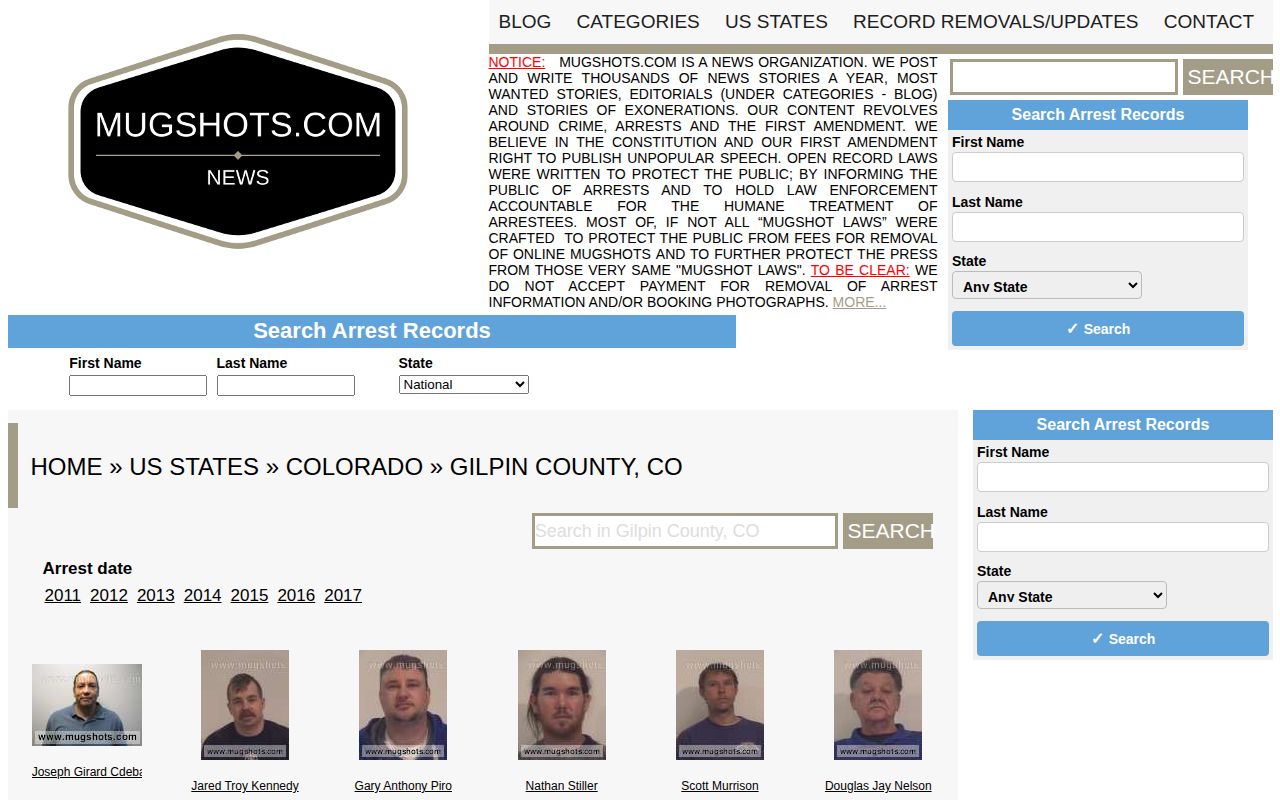
The page is context, not a roster. Confirm names and charges with the sheriff and the court.
Gilpin Weekend Report Gaps
No county source says Gilpin bookings post on weekends or wait until Monday. No set posting hour exists either. So a holiday gap is not an official delay. Detention processing, agency report writing, court scheduling, records-office hours, and newspaper deadlines all run on separate clocks. A burst of holiday stories may reflect timing. It is not proof of a rise in arrests. Colorado's high-visibility enforcement report adds a useful but narrow angle. It flags seasonal, holiday, rally, and festival enforcement involving the Gilpin County Sheriff's Office. News activity can cluster in those stretches. But enforcement contacts include warnings and citations too. The report is no booking log, and its figures should not be read as a resident crime rate.
Note: Gilpin’s visitor and gaming activity makes resident population a poor stand-alone measure of police contacts or report volume.
Unofficial Gilpin Arrest Windows
RecentlyBooked keeps a Gilpin County page. It is labeled as a last-30-days window with a visible update time. The sheriff does not run it. Treat it as a discovery lead at best. Coverage, duplicates, timing, image status, and removal can all drift from the official record. A blank page does not mean no arrest happened. An old entry does not mean someone is still in jail. The Gilpin County section on RecentlyBooked covers exactly that rolling window.
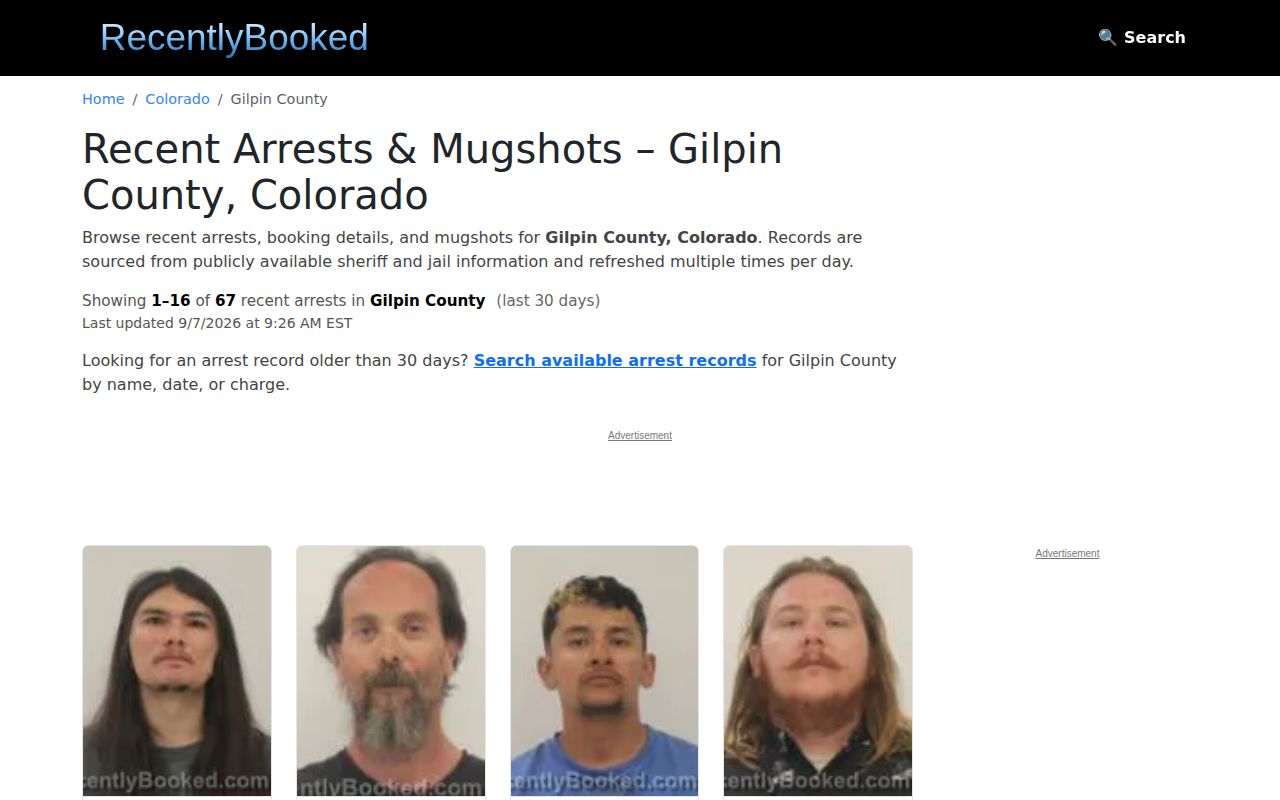
That page is an unofficial interface, not an endorsed roster of Gilpin bookings. Official sources come first. Confirm identity and custody with detention, the source record with the sheriff or arresting police department, and the case outcome with the court. No third-party timestamp sets Gilpin policy.
Archive Gilpin Arrest Reports
Gilpin County has no posted schedule of its own for booking photographs. The general Colorado sheriff records schedule suggests possible periods for routine logs and booking reports. Treat it as a model, not a rule. Before making a request, call the Sheriff's Office. Ask which records series controls the file you want. Find out whether it still exists, too. Ask whether that arrest record is open, sealed, restricted, transferred, or already destroyed.
Older Gilpin arrest material sits with the Colorado State Archives. Its finding aids list historical sheriff jail records for the county. There is a County Jail Arrest Record volume from 1921. Jailor Arrest Record volumes run from 1906 through 1913. These are registers, not a modern mugshot feed. Search by series, volume, and date, then ask staff about access and copies. No complete set of modern booking photos appears to have been transferred there.
For old files, use the State Archives search. Newer Gilpin County arrest records start with the sheriff. Call 303-582-1060 or email records@gilpincounty.org once you confirm the route. The 2026 county fee schedule sets a $5 criminal-justice-record search. It also charges $0.025 per copied page. Other work or formats may cost more.
Arrest Reports Need Court Context
A Gilpin booking record shows the charge at intake. The prosecutor may file something different. Courts can dismiss, amend, defer, or resolve counts later. The Colorado Judicial Branch docket lists scheduled events, and its record request form can seek documents such as a complaint, register of actions, or disposition order.
The Gilpin County recent arrests hub connects the jail, sheriff, court, and state custody channels in one place. Verify names and dates through official records. Do not republish sensitive identifiers. Note the source date whenever you discuss historical news.